
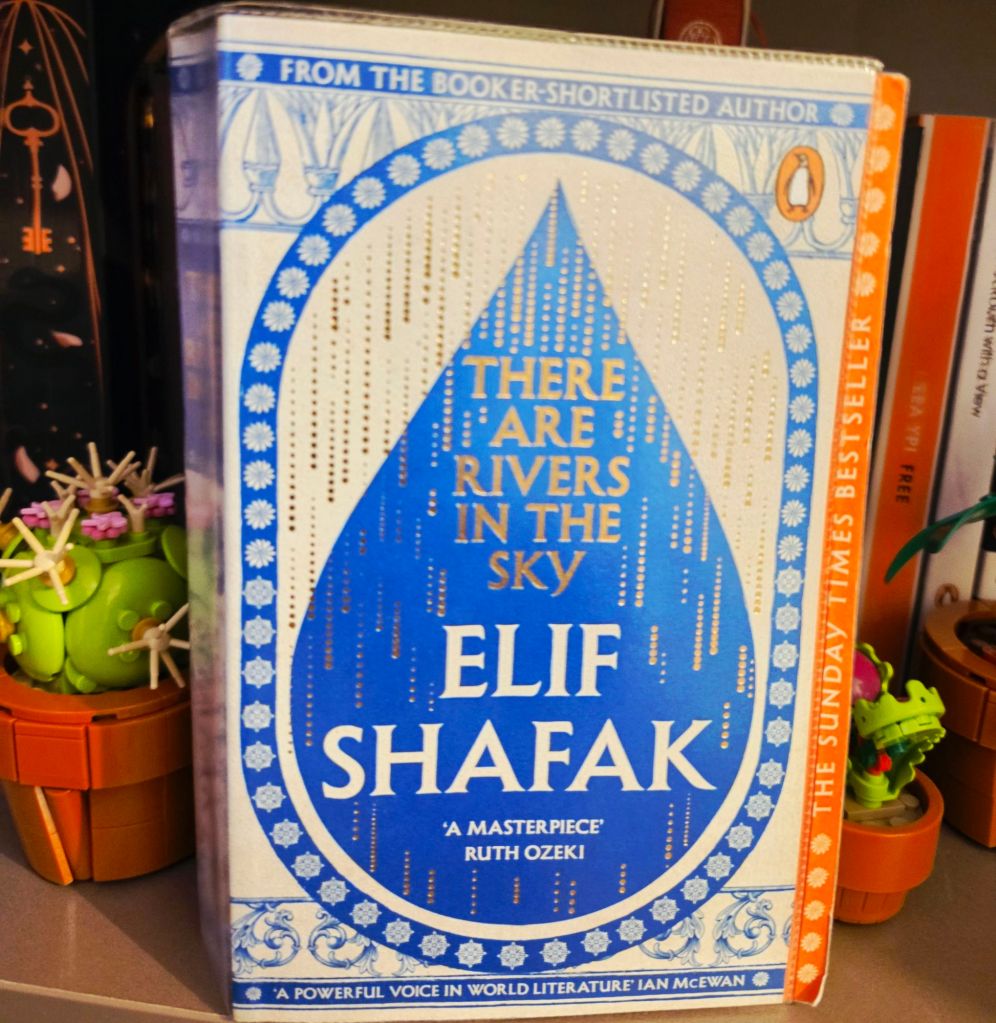
In Victorian London, an extraordinary child is born at the edge of the dirt-black Thames. When his brilliant memory earns him a spot as an apprentice at a printing press, the world opens up far beyond the slums and across the seas.
In 2014 in Turkey, Narin, a Yazidi girl living by the River Tigris, waits to be baptized. The ceremony is cruelly interrupted, and soon she and her grandmother must journey across war-torn lands in the hope of reaching the sacred valley of their people.
In 2018 in London, broken-hearted Zaleekhah, a hydrologist, moves to a houseboat on the Thames to escape the wreckage of her marriage – until an unexpected connection to her homeland changes everything.
A dazzling feat of storytelling from one of the greatest writers of our time, one that spans centuries and continents, this is the story of one lost poem, two great rivers and three remarkable lives – all connected by as single drop of water.
I keep trying to not buy books and instead get them out the library or on audiobook via the library instead. This is one of those books but, alas, now that I have given it a read I want to seek a physical copy out to sit on my shelves because I found the entirety of the plot and writing style to be wonderfully mesmerising and thought-provoking.
But, there’s something about the blurb that stands out to me as a subtle hint of one of the constant themes in this book. The river Thames is simply called “Thames” because it’s something that the Western audience is incredibly familiar with but the Tigris gets introduced as the “River Tigris” as if the author and blurb writers are aware of a disturbingly Western centric circle for geographical knowledge. And the author isn’t subtle about that at all, whichever timeline we are present in, there is talk of Tigris and its surrounding areas as some far-off unimaginable place that we couldn’t locate on a map even if we tried. And it’s a difficult one because I know that there are plenty of people that are unable to do that or understand world geography, however, I think that the nature of the book requires you to have some level of intrigue or understanding to pick it up in the first place. It feels a bit like preaching to the converted on that front.
I’d say that’s where my uncertainly or qualms come to an end. The rest of the book blends seamlessly with a perplexing combination of gentleness and intensity. It’s not just about a droplet of water reappearing with a sense of memory, which is Zaleekhah’s inherited work focus to discover, but about reappearing assumptions about people with certain background or status and the Epic Of Gilgamesh that has its own fluidity in terms of meaning and interpretations.
Perhaps, if anything, I wish it had gone harder on Arthur’s growing guilt and uncertainty and Narin and her families anger about the pilfering of artifacts and destruction of history from countries other than the one those items came from. It stops to ensure we are reminded of the comfortable truth of museums and galleries of historical objects; They are rarely the items of our own past but some ugly display of trophies from colonialism and brutality on those deemed different or lesser by some arbitrary over-privileged group.
I appreciated the lesser spoken about bits of history, like the forgotten goddess, and an explaining of things like the importance of Lapis Lazuli across time and location. The explanation of water and a reminder of hidden rivers across the world was also fascinating. The glimpse into the horrors of a modern day tragedy and brutality without going for physical gore, just a brain itch of discomfort, was tactfully and respectfully done too but again was gentle enough that the messages it was attempting to portray could absolutely be unfortunately swept under the carpet.
Beyond absolutely everything, I think it teaches a key thing about ourselves and our place in the world; We will, much like a drop of water, come into this earth and then be gone. We are just a single droplet and, ultimately, we are meaningless and do not matter when we stand alone. We’ll disappear and either make an impact like being the first drop of rain before a flood or the drop that keeps somebody alive, or we’ll appear and disappear uneventfully. We are unlikely to be truly remembered as an individual or for an individual moment but for a bigger thing or as part of a greater movement in history; We have a choice to make on our actions and whether we are on the good side or the bad side of history through actions, complacency and language.
When you view it from the point of the author being bold and brave enough to discuss and highlight the uncomfortable truths and for doing it in a subtle but consistent way, combined through the most fantastic of plots and writing style, then this is a truly brilliant read.